

UV protection filters ultraviolet radiation, which we cannot see but which can damage the eyes. Polarisation reduces glare from shiny surfaces such as water, wet asphalt and snow. A pair of sunglasses can have one of these properties without the other. How dark the lens is says nothing reliable about either of them.
UV400: the protection you cannot see
UV radiation can harm the eyes in both the short and the long term, and it can be high even when it is cloudy or hazy (DSA, the Norwegian Radiation and Nuclear Safety Authority). UV400 is a common marking: the number refers to 400 nanometres, the boundary to visible light. The Canadian Association of Optometrists recommends looking for «UV400» or «100% UV» on the label.
A dark lens is not the same as UV protection
Both DSA and the Canadian Association of Optometrists stress that you cannot judge how well a lens protects against UV from its colour, darkness or price.
Look for the CE mark
According to DSA, sunglasses must be CE marked to be sold in Europe. In DSA's own test of 35 pairs of sunglasses, all the CE-marked lenses met the requirements for UV reduction.

Polarisation: less glare
Light reflected from a flat, shiny surface becomes largely polarised. It oscillates mainly in one direction, and this is what we experience as dazzling glare. A polarised lens has a filter that blocks much of this light. The result is a slightly darker view with less glare from the water, the road or the snow (20/20 Magazine).
Polarisation is therefore about comfort and visibility in reflected light. It is not UV protection in itself.
When polarisation can be a drawback
Polarised lenses can make some screens and instruments darker or harder to read, depending on the angle. This is one reason they are advised against for pilots, among others (FAA). If you often need to read screens outdoors, for example in a car, on a boat or on your phone, check that they are readable with the sunglasses you are considering.
How dark are the sunglasses? The filter categories
Sunglasses are divided into filter categories according to how much visible light they let through (The College of Optometrists, referring to EN ISO 12312-1:2013):
- Category 0: over 80% to 100%
- Category 1: over 43% to 80%
- Category 2: over 18% to 43%
- Category 3: over 8% to 18%
- Category 4: over 3% to 8%
Category 4 must not be used for driving. For categories 0–3, the sunglasses must also be suitable for road use. The filter category alone does not decide this, so check the manufacturer's marking and instructions for use. Lenses that let through less than 75% of the light are not suitable for driving at dusk or in the dark.
The filter category tells you how dark the lens is. Polarisation and UV filtering are separate properties.
Coverage around the eye
Even a good lens is of little help if light gets in from the sides. DSA recommends sunglasses that also shield from the sides, especially on snow and at sea. Read more about fit and coverage in What does it mean to choose the right sunglasses?
A simple demonstration of polarisation
You can get an indication of whether a lens is polarised:
- Hold the sunglasses in front of an LCD screen showing a bright image, such as a computer screen.
- Look through one lens and slowly turn the sunglasses 90 degrees.
- If the screen becomes clearly darker at one angle, this suggests that the lens is polarised.
Not all screens are suitable, and a screen that does not get darker does not on its own mean that the sunglasses are not polarised. If you have a pair you know is polarised, you can also hold two lenses in front of each other and rotate one of them.
This is only a simple demonstration, not a measurement. It says nothing about UV protection, which can only be measured with instruments.
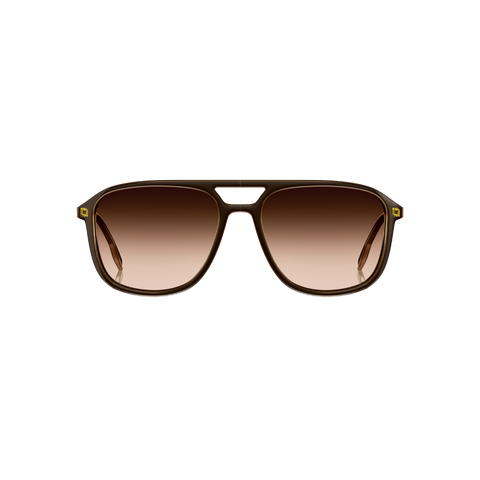
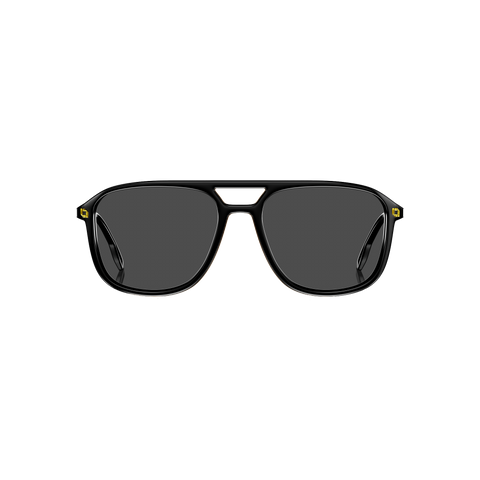
Black or Marrone
Luca Costa comes with two lens colours. The shape and the stated measurements, 55–16–145, are the same.
Luca Costa in black
Dark lenses with an even tint across the whole lens.

Luca Costa Marrone
Brown lenses that are darker at the top and lighter at the bottom, known as a gradient.

Which one you choose is mostly about use and taste. You can compare Luca Costa in black and Marrone side by side. The same measurements do not mean that the sunglasses fit everyone the same way, so feel free to compare with a pair you already own. See the size guide.
Checklist – what can be useful to look for
- UV: Are the sunglasses marked UV400 or 100% UV, and are they CE marked?
- Polarisation: Can be useful if you are often near water, on snow or in strong reflected light. Check that the screens you use are readable.
- Filter category and driving: Does the darkness suit the use, and does the manufacturer state that the sunglasses can be used for driving?
- Coverage and fit: Do the sunglasses fit well, including at the sides?
Sources
- DSA: Hvor godt beskytter solbriller? (How well do sunglasses protect? In Norwegian, updated 21.03.2024)
- The College of Optometrists: Tints and driving (refers to BS EN ISO 12312-1:2013)
- Canadian Association of Optometrists: UV and Eye Protection, Position Statement (2023)
- Siletz: The Physics of Polarizing Filters, 20/20 Magazine (2014)
- FAA: Sunglasses for Pilots (2024)